What is FME?
The only all-data, any-AI platform
TRAINING
Hands-on, practical training for individuals and teams
INTEGRATION
Remove silos, connect all your data and make it usable

CUSTOMER SUCCESS STORY
By leveraging FME to integrate CRM data into a dynamic mapping application, KiwiRail has replaced hours of manual GIS updates with a self-service tool that gives commercial customers a clear, near real-time view of future freight schedules and capacity.





– Dan Swan, Digital Solutions Specialist, Customer Delivery

Responsible for rail operations in New Zealand, KiwiRail plays a vital role in the nation’s freight and supply chain infrastructure. As the custodian of New Zealand’s rail network, it operates 900 freight trains per week and handles 18% of the country’s imports and exports.
Unexpected disruptions, unplanned events affecting train services, can lead to delays or cancellations, making accurate, real-time information critical for customers and highlighting the importance of fast responses during unexpected disruptions.
Before implementing FME, KiwiRail’s GIS team manually updated and published GIS data, a process that took several hours each time. To modernise operations and improve the customer experience, KiwiRail identified the need for an efficient, user-friendly system that would give commercial customers a clear view of future freight schedules and capacity.
To meet this challenge, KiwiRail developed the Interactive Rail Freight Distribution Dashboard, powered by FME. Leveraging FME’s data integration and visualisation capabilities, the dynamic map displays freight scheduling information both spatially and temporally, providing real-time updates on disruptions across KiwiRail’s network.
To support real-time updates, KiwiRail integrated Microsoft Dynamics 365 (D365) via the Dataverse API, ensuring timely delivery of freight data. FME’s automation capabilities significantly reduced the need for manual data handling, empowering the Customer Delivery team to manage and scale the system with minimal effort.
A key enhancement was the use of a SQL recursive script to generate selectable dates within the dashboard’s calendar tool. This refinement centralises and streamlines date-based data, allowing users to easily view any potential freight disruptions for a selected day. The dashboard’s interface makes it easy for both customers and internal teams to access the information they need on demand.
With the introduction of the KiwiRail Interactive Rail Freight Disruption Dashboard, customers now have access to a self-service tool that is simple to use and up-to-date.
The KiwiRail Customer Delivery team can maintain and scale the system as needed without requiring extensive technical intervention, and the advances in automation have dramatically reduced the manual overhead for the Customer Service and GIS teams. The result is a more responsive, efficient, and customer-centric freight experience for New Zealand’s rail operations.
– Lina Le, Asset Services Team Leader, ICT Delivery, KiwiRail
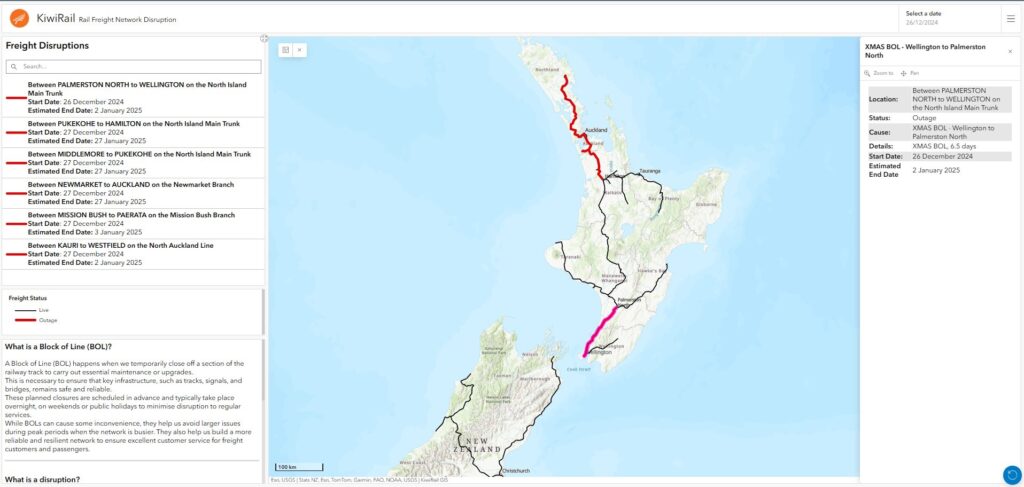
By utilizing FME to orchestrate complex data integration and portal publishing, infrastructure providers can break down internal data silos and streamline information delivery. Automating these data supply chains ensures that critical network insights are consistently available to decision-makers, optimizing operational efficiency and supporting safer, more reliable infrastructure management across the country.
Powered by Locus Expertise
With FME and Locus, KiwiRail created a dynamic dashboard that provides customers with real-time visibility into freight schedules and disruptions, improving communication and reducing manual effort.